
Noblesville City Directory Shelf
Noblesville's historical directory shelf is broad but not annual. Hamilton East Public Library describes holdings from 1874 through 2000 with gaps. The Hamilton County Historical Society lists several early county runs, while the 1916 W. H. Hoffman volume is available as a page-image scan. Later criss-cross books reverse the usual search by starting with an address.
| Collection | Years | Where held | Access |
|---|---|---|---|
| Hamilton County directories | 1874–2000, with gaps | HEPL and Historical Society | In person; selected scans |
| W. H. Hoffman volumes | 1916, 1920, 1922, 1924, 1926, 1929, 1938, 1948 | HEPL and related bibliographies | 1916 scan; physical volumes |
| Haines criss-cross books | 1976–current, with possible gaps | HEPL Indiana Room | Address-first, in person |
| Newspapers | 1837–2008 database; microfilm into 2019 | HEPL | Library, card, or microfilm |
| Yearbooks | 1909–1994, 2000–01, 2003 digital; later physical gaps | HEPL and library database | Digital or in person |
| Mayor Docket Books | 1887–1950 | Indiana Memory and HEPL | Digital browse |
A missing year is not evidence that a person left town. Move to the closest earlier and later volumes, then test newspapers, census schedules, deeds, or vital indexes.
The early shelf includes the 1874 Hamilton County directory, the 1876 People's Guide, an 1893–94 volume, the 1896 Business Directory of Noblesville, a 1902 Central Indiana book, and a 1907 pocket business directory. Later runs include phone, city, atlas, and county formats. Their scope is not identical. A county edition may organize people by township or postal place, while a Noblesville volume may split residents, firms, streets, and rural routes. Record the full title and edition before treating two entries as a year-to-year sequence.
Noblesville Directories at HEPL
The Crossroads Discovery Center online resources connect the Indiana Room's directories with newspapers, local indexes, yearbooks, and digital projects. The Indiana Room is at One Library Plaza in Noblesville and may be used without an appointment. Staff also offer genealogy consultation and two-hour Family Histories appointments.
The capture marks the page-matched starting point. For a hard name, bring the spelling variants, likely years, old address, township, and any known relative so staff can route the search to the right print, film, or index.
Crossroads also holds a climate-controlled archive with material reaching into the 1850s. Digital projects include the 1923 Centennial, school photographs, local newspaper titles, the 1987 City Hall album, and collections tied to transportation and civic life. Access differs by item. Some databases work at home with a library card, some require an in-library session, and physical books or files must be viewed at the desk. When remote access stops, call the library at 317-770-3236 or arrange a research appointment instead of assuming the missing volume does not exist.
Hoffman’s Noblesville City Directories
W. H. Hoffman's 1916 Noblesville directory is the clearest digitized example. Its metadata describes residence, business, street, and rural-route content. The inspected pointers include resident entries on page 103, businesses on page 190, and the street-by-number section on page 215. Page images are 300 dpi JPG files, but no OCR was found in the metadata.
The digitized 1916 directory record supplies page navigation and public catalog details.
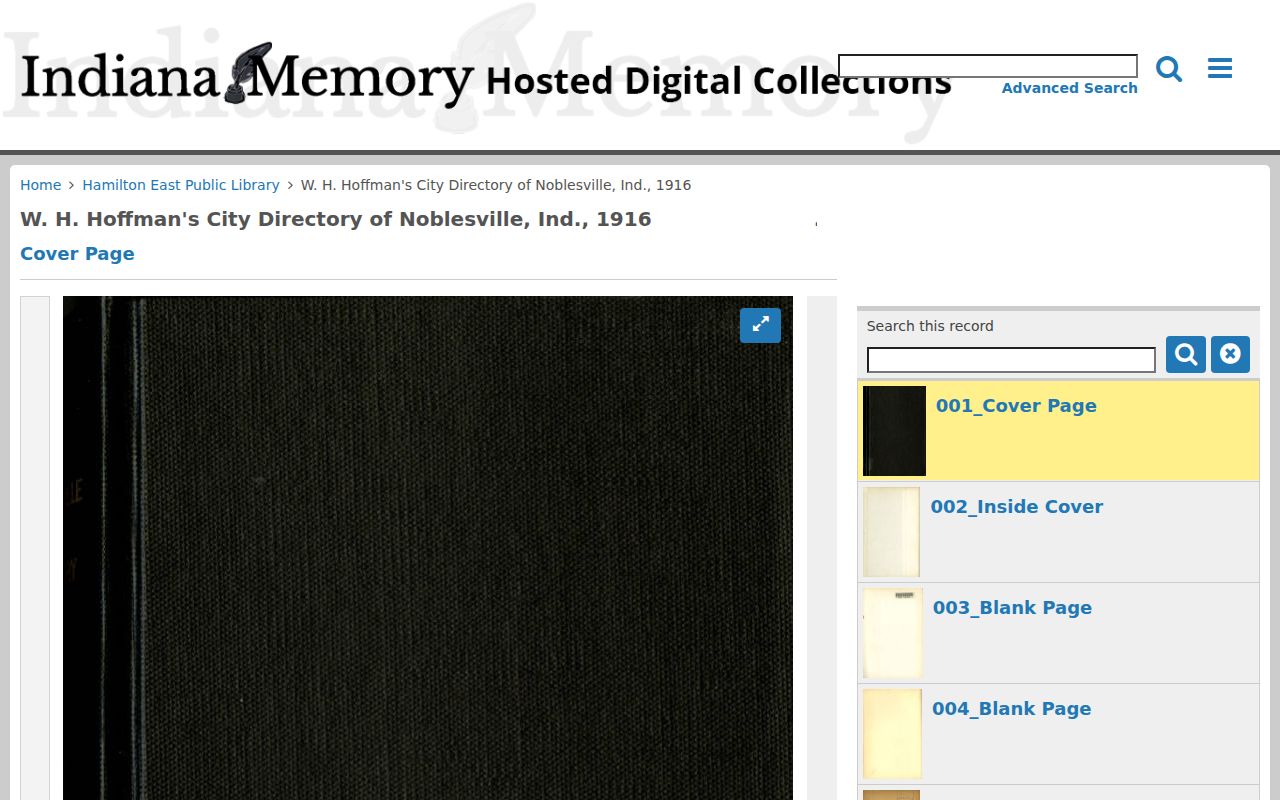
Read the scan itself before quoting a line. Do not expand an initial, standardize a blurred surname, or carry a code from one edition into another without that volume's key.
Read a Noblesville Directory Entry
A city directory entry can be brief. Fields vary by year and publisher, so record exactly what the printed line says and note whether it came from the resident, business, rural-route, or street section.
| Name | Surname, given name, or initials as printed |
|---|---|
| Household clue | Spouse, widow, or other notation when present |
| Work clue | Occupation, business, or affiliation |
| Place | House number, street, cross street, route, or post-office form |
| Status mark | Owner, renter, resident, or boarding code only if the key defines it |
- Criss-cross directory
- An address-first volume used to find a listed occupant or business at a house number.
- Householder index
- A section organized around the person responsible for a household entry, not a full list of every resident.
- Abbreviation key
- The edition's own legend for short forms. Photograph or save it before interpreting entries.
The 1916 layout is a sample, not a promise that later Noblesville city directories use the same fields or codes.
Read across the whole line and then inspect the surrounding page. Nearby entries may reveal alphabetical order, a repeated firm name, or the start of a street section. Rural-route language needs special care because it may not translate to a modern situs address. Business addresses also should not be treated as residences without another source. If the line includes a spouse or widow note, use it as a lead for marriage, obituary, or probate research. Do not infer the unnamed person's full identity from an abbreviation alone.
Reverse Noblesville Directory Searches
HEPL's Haines criss-cross run begins in 1976 and continues to current holdings, though gaps may occur. Start with the house number and exact street spelling. Write down the occupant or business, edition year, and page, then confirm the identity in a name directory, deed, obituary, or other dated record.
Criss-cross results are historical directory listings. They do not prove a person owns the parcel, remains there now, or was the only member of the household. When the goal is a current property chain, the Noblesville street directory method explains the county parcel and deed route.
Noblesville’s Old Address Puzzle
Noblesville Preservation Alliance warns that house numbers changed. The 1916 and perhaps 1920 volumes appear to predate the later scheme, but an exact conversion year and official crosswalk were not located. Avoid forcing a modern house number onto an early entry.
Instead, join the city directory line to Original Plat block and lot, a deed's legal description, Sanborn building shape, nearby addresses, and newspaper notices. The Historical Society holds Sanborn years from 1883 through 1947 at intervals. Those maps can show whether the lot and building footprint stayed stable while the number changed.
Trace Noblesville Family History
City directories fill the years between federal census snapshots. The most recent public individual census is 1950 under the 72-year rule, so directory editions can help track a household's moves between the 1900 through 1950 census years.
- Start with the best-known name, year, and address form. Search initials and likely spelling variants.
- Check the nearest earlier and later Noblesville city directories. Record each address, work clue, spouse or widow notation, and page.
- Use street-by-number pages or later criss-cross books when the name index fails.
- Pair the directory line with the closest released census, keeping township and boundary changes in mind.
- Test a disappearance through the HEPL obituary index, newspapers, cemetery data, probate, marriage records, or a later directory elsewhere.
A missing listing can mean a move, death, spelling shift, publication gap, or choice not to list. Two independent dated sources make a far stronger identification than consecutive directory lines alone.
Noblesville Directory Companion Records
HEPL's newspaper collection spans 1837–2008 in the database, with microfilm extending into 2019. Its Obit File and obituary, marriage, and biographical index can tie a directory name to relatives and a dated newspaper issue. Noblesville High School yearbooks cover many years from 1909 through 2019 across digital and physical formats, with gaps.
Funeral-home books cover 1924–1950, with compiled Hamilton records extending from 1891–1962. The State Library guide points to naturalization certificates from 1855–1905 and records through 1926. Use these as separate evidence sets, not as substitutes for what the city directory actually printed.
Noblesville Mayor Docket Trail
Digitized Mayor Docket Books for 1887–1950 create an unusual bridge between municipal history and a named resident. Search the docket by year, date, and name, compare any address with the closest city directory, then confirm the street or block through a map or newspaper.
These books belong to an older city-court history. They should not be confused with current MyCase records or the present Noblesville City Court. Preserving the book title, page, date, and jurisdiction keeps the historical finding in context.
Noblesville Directory Record Timeline
Noblesville's directory trail fits inside a longer local record history. Hamilton County was created in 1823, and its county-seat offices brought land, court, probate, and later directory evidence into the same city. The dated points below show why no one portal covers the whole span.
| 1874 | Earliest located Hamilton County directory in the local holdings. |
|---|---|
| 1883 | First year in the Historical Society's listed Noblesville Sanborn sequence. |
| 1887–1950 | Mayor Docket Books provide a separate municipal name and date trail. |
| 1916 | W. H. Hoffman volume supplies resident, business, rural-route, and street pages. |
| 1976 | HEPL's Haines criss-cross run begins its address-first coverage. |
| 2000 | Upper end of HEPL's stated local-directory span, with missing years. |
The dates mark holdings, not continuous annual publication. Check the catalog or ask staff which exact edition survives before planning a visit.
Noblesville Directory Research Desks
HEPL is the main connective desk for directories, microfilm, indexes, and digital work. The Hamilton County Historical Society at 810 Conner Street lists early directories, ownership maps, atlases, Sanborn maps, and other street-by-street material. Its holdings page is a collection guide, not a live name search.
Request help by person, year, address, map, or collection. If the exact year is missing, ask for the nearest volume and a companion source. Clear, narrow requests make it easier for staff to check a shelf, page range, or index without guessing which Noblesville record is meant.